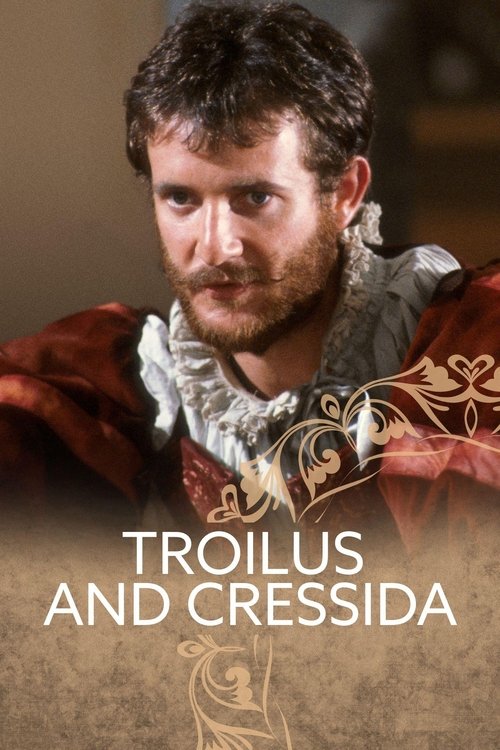
Troilus & Cressida
กำลังโหลด...
1981-11-07
ภาพยนตร์
ผู้อำนวยการJonathan Miller
นักแสดงชายCharles Gray, Anton Lesser, Tony Steedman, Suzanne Burden, Max Harvey
พิมพ์Drama, TV Movie
พื้นที่United Kingdom
ภาษาEnglish
วันที่วางจำหน่าย1981-11-07
คะแนน8.0
เนื้อหาเบื้องต้น
The bitter Trojan War drags on - the Greeks blame Achilles' apathy for low morale, while Troy's hero Hector challenges one of the enemy to a personal duel. And after her father exchanges Cressida for a Trojan prisoner, the war becomes personal for her distraught lover Troilus.

คำแนะนำที่เกี่ยวข้อง
The Narthex-Mosaics of S...
One of the most complete of the preserved image programs of the Middle Ages, at the same time abstract and full of touching details. The creation story, which begins with the big bang, has perhaps not been recorded more precisely anywhere. Also ingenious is the mosaic of the Alypius portal, in which the transfer of the bones of St. Mark to the building in front of which the viewer stands is depicted. A wonderful archive of the development of European art between 1100 and 1290, in which the Romanesque image is increasingly supplemented by vivid backgrounds and in the “Dream of Moses” a whole landscape is already presented under a romantically lying crescent moon. In addition, you can see in the circular compositions of the domes (with partly already framed picture fields) not only an early form of cinema that reminds of the movement experiments by Marey and Muybridge, but also the prototypes of our DVDs today, a round disc with image storage in mosaic -Pixels. - K. Wyborny
Route 66
Four boys from Leeds, England dreamt of this day for over a decade. Now, in the peak of their mid (not late) 20's, they embark on the most famous commute planet earth has to offer. They laugh. They Cry. They fall out. They make up.
The Light of the World
Klaus Wyborny’s STUDIEN ZUM UNTERGANG DES ABENDLANDS had its premiere at the Viennale in 2010, where it got rave reviews. Afterwards it was shown at several film festivals where Wyborny documented the cinema situations with a video camera. Out of that he made DAS LICHT DER WELT. In a letter to Harun Farocki he wrote about the result: “It’s a strange 86-minute film, partly in the form of a superimposition of seven image-layers. It has the same music (played sevenfold) and the same light-structure as STUDIES FOR THE DECAY OF THE WEST, but it takes place in seven different locations simultaneously, in front of competely different audiences. So one can see how the film was brought to the DAS LICHT DER WELT, and how the observed viewers are in some sense illuminated by the very light, that exposed my original films between 1979 and 1993. Quite a haunting prospect.”
Missa do Orfanato
Created from the solemn Mass composed and governed on the occasion of the consecration of the Orphanage Church in Vienna in 1768 by a Mozart who had not yet counted his thirteen years, the 1989 Mass of the Orphanage is among the highest works of the Corpo Group. Already establishing the first codes of a choreographic writing that would reach its maturity three years later with 21, a watershed in the trajectory of the company, Rodrigo Pederneiras transforms his corps de ballet into a mass of devalued people who, contrary to what the ordinary Catholic Mass preaches, portrays rather the tragedy and misery of the human condition that the longing for glorification of the Divine. In a state of permanent contrition, the bodies of the dancers ritualize the helplessness, fear, affliction and loneliness inherent in the inapprehensibly earthly and transitory nature of the human species. In the incessant search for verticality, their convulsive gestures sound like cries of mercy.
Micha Wertheim: Voor All...
Micha Wertheim asks himself and his audience how to live and survive in a gloomy future perspective. Populism seems to have been taken for granted by both right-wing and left-wing parties. Racism, sexism, anti-Semitism seem to be increasing. The planet is dying. The factory farming industry is still booming. We have reached a dead end and we are standing with our noses against a blank wall. All we can do now is turn around to see how we got here, with our backs against the wall.
Triz
The sensation of being just a hair’s breadth away from the blade of the mythical sword of Damocles was so imperative during the entire gestation period of the ballet from Grupo Corpo that it not only became the broad motif, but also inspired its name: Triz, an onomatopoeic term most likely deriving from the Greek triks/trikós (hair), symbolized in the expression por um triz (by a hair). In order to stimulate the creation of the soundtrack for Grupo Corpo’s ballet, Lenine himself placed Damocles’ sword above his own head by constructing a musical topography interlaced with rhythmical subversions (a passion) from a single leitmotif and using only strings. In a work where the occupation of space reflects the diabolical intermittence and guile worked on time by Lenine’s music, the possibility of creating a series of female duos acted as a soothing moment and a pause for breath.
Sem Mim
The ocean (in Vigo), that takes and brings back the beloved one, the friend, is also the one that gives life and movement to Sem Mim. With a choreography by Rodrigo Pederneiras, scenography and lighting by Paulo Pederneiras and costumes by Freusa Zechmeister, the creation of the Brazilian dance group is rocked by the original soundtrack woven by the hands of the Viganese musician and composer Carlos Núñez and by the Brazilian from (“the ocean”) of the city of São Vicente José Miguel Wisnik, from the only set of pieces of music from the Galician-Portuguese medieval profane songbook that got to us with their respective original sheet music: the famous cycle of the ocean in Vigo, by Martín Codax. The seven chants, dated from the XIIIth century, are the oldest testimony and the most appreciated survivals of one of the aspects of the troubadouresque tradition in the region at that time: the so called “friend chants”.
Parabelo
The country side inspiration and the resulting contemporary sound track, written by Tom Zé and José Miguel Wisnik, for 1997’s Parabelo, prompted the choreographer from Grupo Corpo to bring into life that, which he himself refers to, as his “most Brazilian and regional” creation. From working and devotion chants, from the memory of the rhythmic baião and from the exuberant and an ever present, entangled, rhythmic points and counterpoints, emerges choreography full of hip swaying and feet stamping. It’s a ravishing statement of maturity and of the expressive teachings, developed throughout many years, by the maker of Missa do Orfanato and Sete ou Oito Peças para um Ballet. The aesthetic of the votive offerings, from country side churches, inspire Fernando Velloso and Paulo Pederneiras in the creation of the 15 meter X 8 meter panels, which provide support for the ballet’s stage setting.
The Bridle On The Neck
Roman township of San Basilio: Fabio, 7 years old, in Italian a "character", is assigned to a differential class. How the family reacts, what the neighbors say, what the teachers, the principal, the psychologist of the elementary school think: the doubt is that there is no re-education of a child at stake, but the green light for social homologation.
Nazareth
Nazareth is Corpo’s homage to Brazil’s most erudite song writer, Ernesto Nazareth (1863-1934). The 1993 ballet brought together onto stage the impishly sensual Brazilian ballroom dance and Corpo’s trademark sophistication. Composer José Miguel Wisnik wrote the soundtrack based on the works of Nazareth, the inventor of the “Brazilian tango.” He explored the concept of melodic mirroring to operate retrograde computer-generated movements that are assembled into crystalline surprising musical constructions, absolutely original contemporary recreations of Nazareth’s music. These pieces are commentaries, quotes, and variations on Nazareth’s music that point to a host of new exciting directions. Grupo Corpo’s remarkable team of creators worked hard to blend the erudite and the popular in this kinetic/visual rendering of Ernesto Nazareth’s genius.